
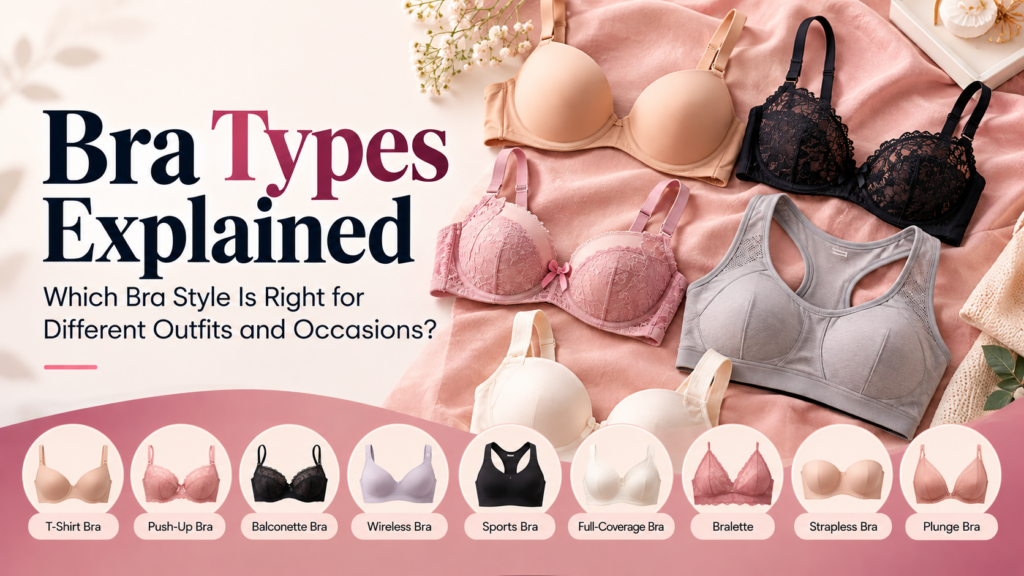
Choosing a bra can sometimes feel confusing. Walk into an online lingerie store and you may see T-shirt bras, wireless bras, push-up bras, bralettes, sports bras, full-coverage bras and many other designs.
The good news is that you do not need to understand every bra style before making a purchase.
The simplest approach is to understand what each style is designed to do and then choose according to your clothing, comfort, support needs and personal preference.
A bra that works beautifully under one outfit may not be the most practical choice under another. Similarly, a bra that feels comfortable during a relaxed day may not provide the type of support you want during physical activity.
This guide explains common bra types, their general characteristics, and situations where each style may be useful.
Quick Answer: Which Bra Should You Choose?
There is no single best bra for every woman.
Your choice should depend on:
- The clothing you plan to wear
- The amount of coverage you prefer
- Your desired level of support
- Your comfort preferences
- Your activity
- The shape and construction of the bra
A practical lingerie wardrobe can include several styles instead of relying on one bra for every situation.
1. T-Shirt Bra
A T-shirt bra is generally designed with smooth cups that create a relatively clean appearance beneath fitted clothing.
This makes it a popular option for everyday wardrobes.
When Can a T-Shirt Bra Be Useful?
It may work well with:
- Fitted T-shirts
- Thin tops
- Office clothing
- Dresses
- Smooth fabrics
- Everyday outfits
The main attraction is usually its relatively smooth appearance.
What Should You Check?
Look at:
- Cup coverage
- Band fit
- Strap comfort
- Cup shape
- Visibility under clothing
Remember that a T-shirt bra is not automatically the right choice for everyone. The fit still matters.
2. Wireless Bra
A wireless bra does not use an underwire.
Many women choose wireless designs when they want a less structured feeling.
Why Choose a Wireless Bra?
Possible reasons include:
- Everyday comfort
- Relaxed clothing
- Home wear
- Preference for less structure
- Lightweight feel
A wireless bra can be especially appealing when comfort is the main priority.
However, support varies between designs, so check the construction rather than assuming all wireless bras provide the same experience.
3. Push-Up Bra
A push-up bra is designed to provide additional lift and create a more enhanced appearance.
It may be selected for particular outfits or occasions.
When Might You Consider One?
A push-up design can be useful when you want:
- More lift
- A defined shape
- A particular neckline appearance
- A more structured look
Comfort should still be considered.
If the design feels uncomfortable after a short period, it may not be suitable for extended wear.
4. Full-Coverage Bra
A full-coverage bra generally provides more coverage across the breast area.
It can be useful for women who prefer:
- Greater coverage
- A secure feeling
- Everyday support
- Less exposure around the neckline
Full coverage does not automatically mean better or worse.
It simply describes a different design approach.
5. Bralette
A bralette is generally a lighter and less structured type of bra.
Some bralettes are designed with minimal support, while others can have more supportive construction.
They are often selected for:
- Casual wear
- Relaxed outfits
- Comfort
- Layering
- Personal style
Because designs vary considerably, check the product specifications before buying.
6. Sports Bra
A sports bra is designed for physical activity.
The support level should match the activity.
For example, a design suitable for light movement may not provide the same support that someone prefers for higher-impact exercise.
When Choosing a Sports Bra, Consider:
- Type of activity
- Support level
- Fit
- Shoulder comfort
- Fabric
- Moisture management features where applicable
The key is to choose based on the activity rather than simply buying a sports bra because it looks athletic.
7. Strapless Bra
A strapless bra is designed without conventional shoulder straps.
This makes it useful with certain outfits such as:
- Strapless dresses
- Off-shoulder tops
- Certain evening outfits
The most important consideration is stability.
A strapless design needs to remain appropriately positioned during normal movement.
8. Balconette Bra
A balconette bra generally has a more open neckline and is designed to provide lift and shaping.
It can work well with certain lower or wider necklines.
This style is often chosen when the bra itself needs to complement the shape of the clothing.
9. Plunge Bra
A plunge bra has a lower center front between the cups.
This can make it suitable for clothing with a deeper neckline.
Consider a Plunge Style When:
- The outfit has a lower neckline
- You want less visible fabric at the center
- The bra’s shape complements the clothing
Again, fit remains essential.
10. Nursing and Maternity Bras
These bras are specifically designed around pregnancy and breastfeeding needs.
They can include features such as:
- Adjustable construction
- Easier access
- Flexible materials
- Additional comfort considerations
Because body changes can occur during pregnancy and after childbirth, fit should be reassessed rather than relying on an older bra size.
Bra Types at a Glance
| Bra Type | General Feature | Common Use |
|---|---|---|
| T-Shirt | Smooth cups | Everyday clothing |
| Wireless | No underwire | Comfort |
| Push-Up | Added lift | Shaping/special outfits |
| Full-Coverage | More coverage | Everyday wear |
| Bralette | Light structure | Casual wear |
| Sports Bra | Activity-focused support | Exercise |
| Strapless | No shoulder straps | Strapless outfits |
| Balconette | Open neckline | Certain necklines |
| Plunge | Lower center | Deeper necklines |
| Nursing | Feeding-friendly design | Nursing period |
How to Choose the Right Bra Style
Instead of asking:
“Which bra is the best?”
Ask:
“Which bra is best for this particular purpose?”
This simple change can make shopping easier.
Step 1: Think About the Outfit
Look at the neckline, fabric and fit of your clothing.
A smooth bra may be useful under fitted clothing, while a plunge style may work better with a deeper neckline.
Step 2: Consider Your Comfort
Ask:
- Is the band comfortable?
- Are the straps comfortable?
- Do the cups provide suitable coverage?
- Can you move naturally?
- Does anything dig into your skin?
Step 3: Consider the Activity
An everyday bra and a sports bra are designed for different purposes.
Choose according to how you plan to use it.
Step 4: Check the Size Guide
Do not assume that the same labeled size will feel identical across all brands and styles.
Manufacturing, construction and fabric can affect fit.
Can One Bra Be Used for Everything?
Technically, you can use one style for many situations, but a small variety can make a wardrobe more practical.
For example:
- Everyday T-shirt bra
- Comfortable wireless bra
- Sports bra
- Special-occasion style
The exact collection depends on your lifestyle.
Common Bra Shopping Mistakes
Choosing Only by Appearance
A beautiful design still needs to fit properly.
Buying Without Checking Measurements
Sizing can differ between brands.
Ignoring the Clothing
The wrong bra shape may become visible under certain outfits.
Wearing a Sports Bra for Every Situation
Sports bras are designed for activity and may not be the most practical choice for all clothing.
Keeping an Uncomfortable Bra
If a bra consistently feels wrong, reassess the size or style.
How to Care for Different Bra Styles
Always check the manufacturer’s care instructions.
This is particularly important for bras containing:
- Lace
- Elastic
- Padding
- Underwire
- Delicate fabrics
Correct care can help maintain the garment’s shape and condition.
When Should You Replace a Bra?
Look for signs such as:
- Weakened elastic
- Damaged fabric
- Broken hooks
- Distorted cups
- Loss of shape
- Persistent discomfort
- Straps or components no longer working correctly
There is no universal replacement date because frequency of use and care differ.
Frequently Asked Questions
Which bra is best for everyday wear?
A comfortable everyday style such as a T-shirt bra, wireless bra or full-coverage design can work depending on your clothing and personal preferences.
Is a wireless bra supportive?
It can be, but support depends on the design, construction and fit.
Which bra is suitable for exercise?
A sports bra designed for the level of activity is generally the relevant choice.
Is a push-up bra suitable for daily use?
It can be if it fits comfortably and suits your preferences. There is no requirement to use it only for special occasions.
Do I need different bra types?
Not necessarily, but having different styles can make it easier to match different clothing and activities.
Final Thoughts
Bra shopping becomes much simpler when you understand that different styles have different purposes.
Rather than searching for one universally “best” bra, focus on fit, comfort, support, clothing and activity.
A practical wardrobe can contain a few carefully selected styles that serve different situations.
The right bra is ultimately the one that suits your body, your clothing and your lifestyle.
For Mallfella readers, understanding these differences can make online lingerie shopping more informed and less confusing.
Hi, this is a comment.
To get started with moderating, editing, and deleting comments, please visit the Comments screen in the dashboard.
Commenter avatars come from Gravatar.